Generate a transition-state guess, then let a platform verify it
Transition-state searches often start from a hand-built guess. This case asks whether a model can produce that guess directly: given the reactant geometry and the bond that must form and the bond that must break, output a single XYZ structure that a standard quantum-chemistry workflow can use. The model generates; the platform optimises, checks frequencies and runs the IRC.
The task
- System
- 8 atoms, C₁H₂N₄O₁; intramolecular O→N proton transfer in a nitrogen-containing five-membered ring
- Target change
- Break O1–H8, form N7–H8. H5 is not the transfer hydrogen
- Input
- Reactant XYZ coordinates, the forming/breaking bond indices, and output constraints
- Output
- One XYZ structure with the same atoms and atom order
- Not provided
- Recommended TS bond lengths, structure adjustments or reference TS coordinates; charge and multiplicity were not specified in the original prompt
Model output
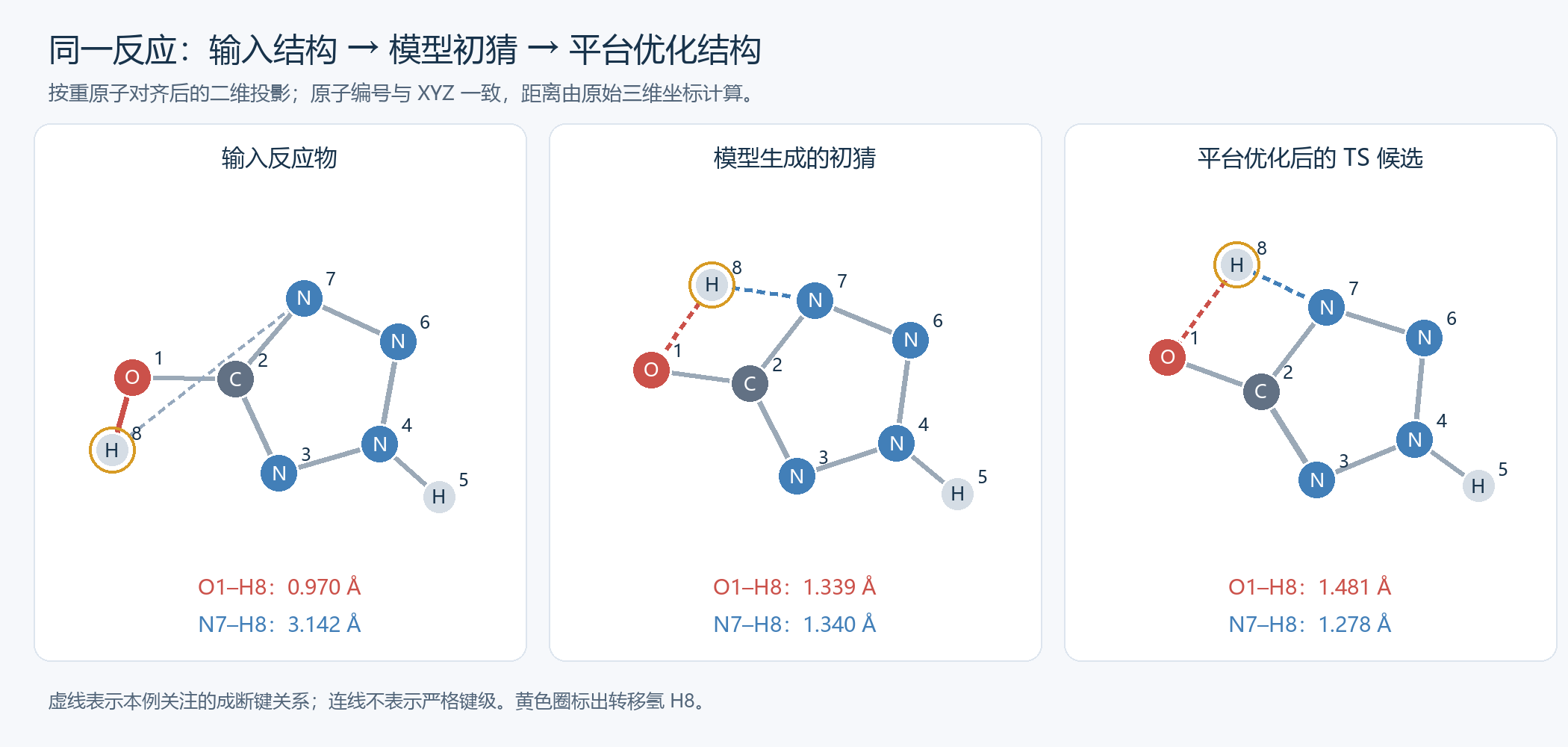
The model returned a parseable XYZ. It assumed charge 0 and singlet multiplicity (not specified by the task), placed H8 between O1 and N7 with both distances around 1.34 Å, and moved O1 slightly. It stated that the geometry was not energy-, frequency- or IRC-validated.
Platform validation
- Engine
- Psi4, B3LYP/6-31G*, charge 0, singlet, 4 cores / 8 GB, IRC max 40 steps
- Task status
- Completed, 100%, no execution errors
- TS optimisation
- Reported converged
- Frequencies
- 18 modes, one negative: −1860.62 cm⁻¹; frequency check valid
- Imaginary mode
- Largest displacement on H8; mode/bond mismatch check negative; overlap metric 0.7544 (not a percentage accuracy)
- IRC
- 15 forward points, 18 reverse points, both converged and not truncated
- Endpoint geometries
- Reactant endpoint O1–H8 ≈ 0.972 Å; product endpoint N7–H8 ≈ 1.011 Å
- Final validity
- Not valid; barrier quality flagged as
endpoint_saddle

What passed and what failed
The model identified the requested reaction centre and produced an input the platform could compute. The platform found a genuine saddle point candidate: the optimisation converged, the frequency list contains a single significant imaginary mode dominated by H8, and the IRC traced both directions. What failed is the final endpoint validation: the endpoints were labelled as saddle points rather than stable minima, so the run cannot be counted as a verified target transition state.
Why one imaginary frequency is not enough
A correct-format guess, a completed calculation and one imaginary frequency do not by themselves prove that a validated transition state for the intended reaction has been found. The endpoint check is part of the verification, and it did not pass here.
The case explicitly notes that the evidence cannot attribute the failure entirely to the model, nor show that the platform's verdict is wrong: endpoint frequencies and more detailed optimisation logs would be needed to separate an incomplete endpoint relaxation from a path that explored too little ring flexibility.
Other models in the same batch
Four models returned parseable XYZ files in the same evaluation batch. Only one guess has a full platform validation in this case; the others were not validated, so they are neither successes nor failures. Labels are local to this table; identities are available to reviewers on request.
| Model label | O1–H8 | N7–H8 | Validation in this case |
|---|---|---|---|
| Model A | 1.339 Å | 1.340 Å | failed endpoint check |
| Model B | 1.312 Å | 1.289 Å | not validated |
| Model C | 1.108 Å | 1.344 Å | not validated |
| Model D | 1.659 Å | 1.615 Å | not validated |
Availability
The full case record (prompt, model XYZ outputs, platform validation logs) is available to reviewers on request. Model identities are disclosed with the record.